


News

2024-05-06
Distinguished Visiting Professor of SUSTech Joseph Sifakis elected as international member of U.S. National Academy of Sciences
The National Academy of Sciences (NAS) of the United States recently announced the election of 120 members and 24 international members in recognition of their distinguished and continuing achievements in original research. Among them, Joseph Sifakis, Distinguished Visiting Professor of the Southern University of Science and Technology (SUSTech), was elected as an international member of NAS. Joseph Sifakis is a member of the French Academy of Sciences, the French National Academy of Engineering, Academia Europea, and the American Academy of Arts and Sciences. With a career dedicated to research in software engineering, embedded systems, and formal verification, he has achieved original and pioneering breakthroughs in these fields. His contributions include the development of novel theories and methodologies in model checking, effectively applied in industry for real-time system security verification. In 2007, he was honored with the Turing Award by the Association for Computing Machinery (ACM) for his outstanding contributions to model checking theory and practice. Joining SUSTech in 2019 as a Distinguished Visiting Professor within the Department of Computer Science and Engineering, Joseph Sifakis also holds the position of Dean of the Research Institute of Trustworthy Autonomous Systems (RITAS). RITAS, under Professor Joseph Sifakis’s leadership, spearheads research in trusted intelligent autonomous systems, exploring key frontiers such as computational intelligence, trusted software, autonomous driving, smart cities, and smart healthcare. Through pioneering research in cutting-edge artificial intelligence technologies, RITAS aims to foster the development of scientific and technological talent and contribute to the industrial advancement of Shenzhen. Related link: https://www.nasonline.org/news-and-multimedia/news/2024-nas-election.html

2019-11-23
SUSTech Visiting Distinguished Professor Joseph Sifakis elected as CAS Foreign Academician
November 22nd saw Distinguished Visiting Professor Joseph Sifakis of the Department of Computer Science and Engineering (CSE) at Southern University of Science and Technology was elected as a foreign academician of the Chinese Academy of Sciences (CAS). The 2007 Turing Award Winner was one of 20 foreign members to be elected, along with 64 Chinese nationals who became CAS academicians. Professor Joseph Sifakis joined SUSTech in 2018 and will soon launch his “Turing Master Class” program using his knowledge of cross-disciplinary fields to promote the development of intelligent scientific and technological industries, while striving to cultivate interdisciplinary thinking skills. The program will focus on fields such as artificial intelligence, computing and big data, while considering multi-disciplinary projects in biology, electronics, automation and other such fields to give play to the development of intelligent science and technology. Students coming out of his program will be the future leaders with interdisciplinary thinking and the ability to be comprehensive innovative designers that can implement scientific and engineering solutions for the betterment of society. On November 1st, the Sifakis Research Institute of Trustworthy Autonomous Systems (RITAS) received approval from the Shenzhen city government at the Shenzhen Talent Bole Awards. It seeks to cover cutting-edge fields such as computational intelligence, trusted software, autonomous driving, smart cities, and intelligent healthcare. Embedded with the Department of Computer Science and Engineering (CSE), it will develop a new generation of Artificial Intelligence (AI) applications while collaborating with the Shenzhen Key Laboratory of Computational Intelligence. The resultant research will ultimately contribute to the cultivation of high-end scientific and technological talent, Shenzhen’s technical improvement, and the dual development of Shenzhen and the Greater Bay Area. Professor Sifakis is a member of the French Academy of Sciences, the French National Academy of Engineering, Academia Europea, the American Academy of Arts & Sciences and the National Academy of Engineering (USA). He has long been engaged in a wide range of computer science fields such as rigorous system design, component-based construction, and model checking, in which he has made original and pioneering achievements. He won the Turing Award in 2007 for his contribution to the theory and application of model checking, the most widely used system verification technique today.

2019-11-01
Sifakis Research Institute of Trustworthy Autonomous Systems unveiled
As part of Shenzhen Talent Day and SUSTech receiving its fourth consecutive “Talent Bole Award,” Distinguished Professor Joseph Sifakis of the Department of Computer Science and Engineering (CSE) at Southern University of Science and Technology (SUSTech) unveiled the Research Institute of Trustworthy Autonomous Systems (RITAS). Shenzhen Municipal Party Committee Secretary Wang Weizhong presented the plate to Professor Sifakis (Turing Award winner), in front of Shenzhen Mayor Chen Rugui, SUSTech President Chen Shiyi and other high-ranking officials from SUSTech and the Shenzhen government. Professor Sifakis is a member of the French Academy of Sciences, the French National Academy of Engineering, the European Academy of Sciences, the American Academy of Arts & Sciences and the National Academy of Engineering (USA). He has long been engaged in a wide range of computer science fields such as rigorous system design, component-based construction, and model checking, in which he has made original and pioneering achievements. He won the Turing Award in 2007 for his contribution to the theory and application of model checking, the most widely used system verification technique today. The Sifakis Research Institute of Trustworthy Autonomous Systems (RITAS) seeks to cover cutting-edge fields such as computational intelligence, trusted software, autonomous driving, smart cities, and intelligent healthcare. Embedded with the Department of Computer Science and Engineering (CSE), it will develop a new generation of Artificial Intelligence (AI) applications while collaborating with the Shenzhen Key Laboratory of Computational Intelligence. The resultant research will ultimately contribute to the cultivation of high-end scientific and technological talent, Shenzhen’s technical improvement, and the dual development of Shenzhen and the Greater Bay Area.
2019-03-12
Turing Award winner Joseph Sifakis: Independent systems will change the future
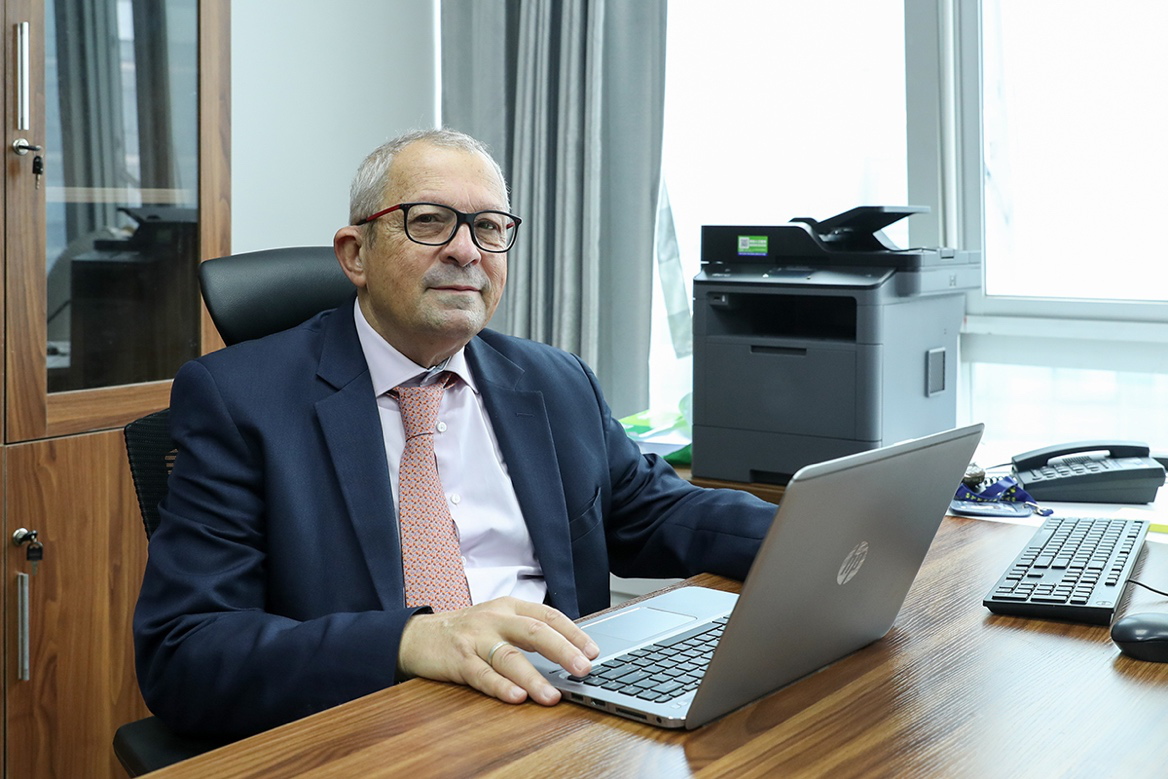
Many people find the concept of autonomous systems strange. However, with unmanned aerial vehicles (UAVs) and unmanned shops already in existence today, autonomous systems are already in our lives and are starting to play a more significant role in them. There is good reason to believe that autonomous systems will occupy an essential place in the future “smart age.” Joseph Sifakis Joseph Sifakis is an expert in autonomous systems. He is an honorary researcher at the French National Research Center, and the founder of the Verimag Lab, a research center known as the Embedded System in Grenoble, France. In 2007, Joseph Sifakis received the Turing Award, known as the Nobel Prize in computing for his contribution to the theory and application of model checking, which is the most widely used system verification technology in the world. On January 7th, 2019, this internationally renowned scientist embarked on a new journey to becoming a distinguished professor at Southern University of Science and Technology (SUSTech). He aims to carry out more collaborative projects at SUSTech, bringing new opportunities to the university that is deeply rooted in innovation, research and entrepreneurship. During the two-hour interview, Joseph talked about his deep understanding of the significant scientific issues such as autonomous systems and artificial intelligence and ruminated on the development of computer science and his relationship with SUSTech. Multidisciplinary background is good for inspiration In 1946, Joseph Sifakis was born in Heraklion, Greece. During his student days, he studied at the Department of Electrical Engineering at the National University of Science and Technology in Athens, Greece, and also had a keen interest in physics. But after coming to France, the young Joseph Sifakis came into contact with computer science by chance. He was quickly attracted to this subject, changed his major, and continued further down this path. In 1981, Joseph Sifakis met the like-minded Edmund M. Clarke and E. Allen Emerson, who together developed model checking techniques to make an efficient verification technology that is widely used in the hardware and software industries. In the process of Joseph’s study of computer science, one of the most influential people was an applied mathematician. Joseph said that this mathematician changed the way he looked at issues, as it encouraged him to communicate with people from different disciplines. It also brought him sparks of inspiration and innovation. Joseph believes that learning computer knowledge is the foundation of many areas of academia. If you want to create something, it is best to have a diverse academic background. One of his doctoral candidates has been an expert in electrical engineering and automation, with a strong experience in multiple disciplines, and Joseph himself has a background in electrical engineering and computer science. “When you decide to study computer science, you shouldn’t just be content to be a programmer. Your goal should be to design an influential program or system.” Joseph suggested to SUSTech students who are interested in learning computer science that they “should study hard, and creativity is also important.” Joseph is a person who is willing to listen to different opinions. In the process of dealing with others, he is also easy to absorb the bright spots in other people’s thoughts. “I have met and talked to a lot of interesting people. Their way of thinking can influence me in subtle ways.” His current achievements are inseparable for his willingness to listen and accept other people’s thoughts. How far away is the “smart age?” With the rapid improvement of the technical level of computer science, the Internet of Things (IoT) has been recognized as one of the three major technologies in the future with artificial intelligence and AR/VR. IoT is the Internet of objects, a vast network formed by the combination of communication sensing technology such as intelligent sensing, recognition technology and pervasive computing and the Internet. Within this network, each device can automatically work and respond to changes in the environment. They will exchange data with other devices without human intervention. These devices could include smartphones, headsets, cars, light bulbs, refrigerators, coffee machines, security system and alarm systems. Scientists believe this is the ultimate vision for a smart city, full of information and communications technology Autonomous systems are critical technology to truly realize this vision. These systems would be able to perform these tasks on their own, without human interference or intervention. “Autonomous systems are intelligent, which means that machines can replace human roles in many areas,” Joseph told reporters. “It’s a wide range of general intelligence, not just chess. It will look like simple behavior but developing multiple skills to cope with more complex and challenging environments.” The development of computer science is changing daily with the rapid growth of components and the increasing computing power available. The use of cloud computing and data analytics has created tremendous opportunities. However, there are still many challenges for autonomous systems technology. “The biggest challenge facing autonomous systems today is security,” Joseph said. “Autonomous systems make decisions without human supervision. If an autonomous system is compromised, this will cause problems. Organizations need more money to ensure that the closed-loop system of the autonomous system is not disturbed.” Joseph also talked about the technical issues of ensuring consistent signal communications. This problem needs to be solved in the future to ensure the proper management of autonomous systems in the future, particularly autonomous vehicles. When it comes to artificial intelligence issues that people care about, Joseph says it’s too early to talk about artificial intelligence. While many Western companies have made many impressive achievements, the current technological development is far from the artificial intelligence of the future. Although the autonomous system is currently not mature enough, it has broad development prospects. As science and technology advances, this emerging technology is sure to benefit humanity. Joining SUSTech to create an ideal blueprint In June 2018, under an occasional opportunity, Joseph met with Yao Xin, the head of the Department of Computer Science and Engineering at SUSTech. In his conversation with Yao Xin, Joseph became interested in SUSTech. He believes that as an emerging university, SUSTech has a different charm from other traditional universities. SUSTech is also an open university where he can achieve many different things and find new inspiration for future projects. “Shenzhen is also a reason to attract me to SUSTech,” Joseph said with passion and excitement. “Shenzhen has a unique geographical location and conditions. The Guangdong-Hong Kong-Macau Greater Bay Area has become a hot topic of discussion for people. I think Shenzhen has the necessary conditions to become a beacon of innovation and the Silicon Valley of the East. I am looking forward to seeing this vision come true.” Joseph is ambitious to come to SUSTech, which is shouldering the mission of China’s higher education reform, and Shenzhen, which is known as the “City of Innovation.” He will work on some collaborative projects, such as software and hardware for autonomous systems. Joseph also has some long-term goals on a global scale, and he hopes to carry out some groundbreaking projects, such as autonomous vehicles and smart cities. He believes that if the smart city project can be realized, it will radically change the global real estate industry. “I like China very much. Chinese people love learning and are willing to listen and think. I hope to be able to turn some ideas into reality here,” Joseph said.
2019-01-22
Turing Award winner lectures on his interpretation of the autonomous system
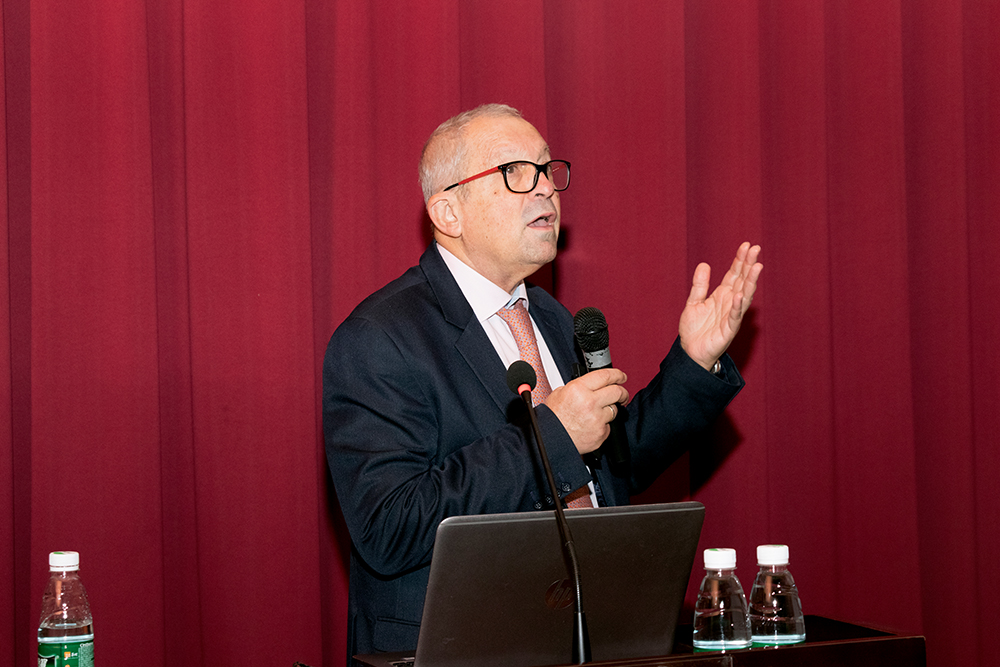
January 15th saw Joseph Sifakis, winner of the 2007 Turing Award, come to Southern University of Science and Technology (SUSTech). Not only was he joining SUSTech as a distinguished visiting professor, but he came to give the 209th lecture in the SUSTech Lecture Series. Professor Sifakis spoke about “Autonomous Systems – A Rigorous Architectural Characterization.” President Chen Shiyi attended the lecture presented Joseph Sifakis with the guest certificate of SUSTech. Director Yao Xin of the Department of Computer Science and Engineering presided over the lecture. Joseph Sifakis officially joined the Department of Computer Science and Engineering at SUSTech at the beginning of 2019 as a Distinguished Professor. He is an Honorary Fellow of the French National Center for Scientific Research and the founder of the Verimag Laboratory in Grenoble. He is also a Fellow of the French Academy of Sciences, the French National Academy of Engineering, the European Academy of Sciences, the American Academy of Arts and Sciences and the National Academy of Engineering. His research mainly includes the basic concepts and applications of system design, implementing a reliable, optimized and correctly constructed system according to specific requirements. In 2007, Joseph Sifakis was awarded the Turing Award, generally regarded as the Nobel Prize of computing by the American Computer Society (ACM) for his outstanding contributions to the theory and application of model checking. Joseph Sifakis pointed out that the vision for Internet of Things is to achieve “autonomy”, which is to integrate smart services better into the system and minimize human intervention. Based on the design of autonomous systems, Joseph Sifakis proposed a general-purpose computing model that combines the system architecture model with the agent model to adjust the relationship between the “agent” and the “object” in the autonomous system. The architecture model combines five basic aspects of perception, knowledge base, goal management, planning and adaptation. This enables the system to independently implement dynamic reconfigurable multi-mode coordination, according to various sudden environmental conditions, so that the system can accomplish tasks autonomously. Subsequently, Joseph Sifakis illustrates the difficulty of constructing an autonomous system at this stage by comparing the gap between machine autonomy and human-assisted machine autonomy at this stage. Joseph Sifakis stated that autonomous systems should not only focus on implementation, but should emphasize the system’s functional design and establish an autonomous system of “trustworthiness” and “optimization”. During the Q&A session, the students enthusiastically asked questions and exchanged ideas and experiences on the face-to-face with the masters.
